Stop waiting for the “spark.” Learn why motivation is chemically flawed and how to build the discipline of a pro. Discover the A.C.T. framework to take control today.
Let’s have a heart-to-heart.
It’s 2:00 AM. You just finished a 15-minute “Sigma Male” or “Girlboss” montage on YouTube. Your heart is racing. You feel like you could run through a brick wall. You’ve decided—right here, right now—that tomorrow is the day everything changes. You’re going to be a titan. A machine. A success story.
Then the sun comes up.
The alarm screams at 6:00 AM. Your room is cold. Your back aches. That “titan” from last night? He’s gone. In his place is a tired, regular human who just wants five more minutes of sleep.
If you ask me, the biggest scam in the self-help world isn’t the expensive courses or the fake gurus—it’s the idea that you need to feel like doing something in order to do it. We’ve become “motivation junkies,” constantly hitting the needle of external inspiration just to get a temporary high that lasts until the first sign of resistance.
Believe me, if I only worked when I felt “motivated,” you wouldn’t be reading this. This article wouldn’t exist.
Today, we’re going to kill the “spark.” We’re going to look at the cold, hard science of why your brain is biologically wired to keep you average, and we’re going to steal the blueprints from the most disciplined humans on earth to show you how to build a life that doesn’t depend on how you feel.
Table of Contents
1. The Dopamine Trap: Why Motivation is Chemically Flawed
We need to talk about what’s actually happening in your skull.
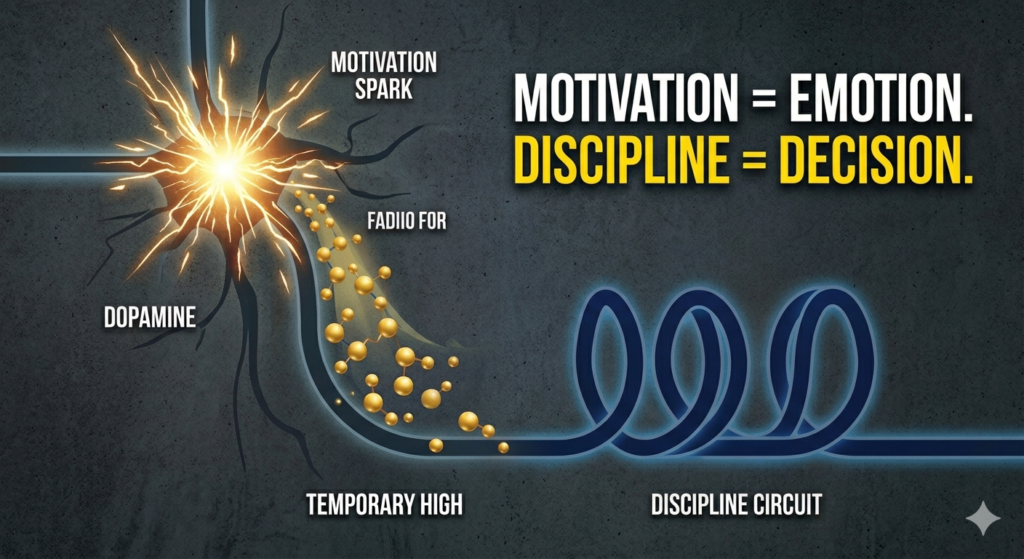
When you get that surge of motivation, your brain is flooding your system with dopamine. Now, most people think dopamine is about pleasure. It’s not. It’s about anticipation. It’s the “reward-seeking” chemical. When you imagine your future success—the fit body, the bank account, the respect—your brain gives you a “free sample” of the reward before you’ve done a single lick of work.
This is why “fantasizing” about your goals is actually dangerous. Research shared by Dr. Andrew Huberman, a neuroscientist at Stanford, in his deep dives on Dopamine and Drive, explains that when we celebrate a goal before achieving it, our baseline dopamine drops afterward. You’ve already “spent” the chemical energy on the fantasy.
By the time you actually have to pick up the weights or open the laptop, you’re in a dopamine deficit. You feel flat. You feel “uninspired.”
The Truth You Don’t Want to Hear:
You think you’ve lost your “spark.” You haven’t. You’ve just exhausted your neurochemistry by dreaming instead of doing. Motivation is a fair-weather friend. It shows up for the party, but it’s never there to help you clean up the mess at 4:00 AM.
2. “I Don’t Feel Like It” is a Lie
We’ve been conditioned by a comfort-obsessed culture to believe that “not feeling like it” is a valid reason to stop.
Think about it. We use it for everything.
- “I didn’t go to the gym because I didn’t feel like it.”
- “I didn’t call my mom because I didn’t feel like it.”
- “I didn’t work on my side hustle because the ‘vibe’ wasn’t right.”
Can you imagine if a pilot flying your plane decided not to land because he “wasn’t feeling the vibe”? Or if a surgeon decided to stop mid-operation because he “lost his motivation”?
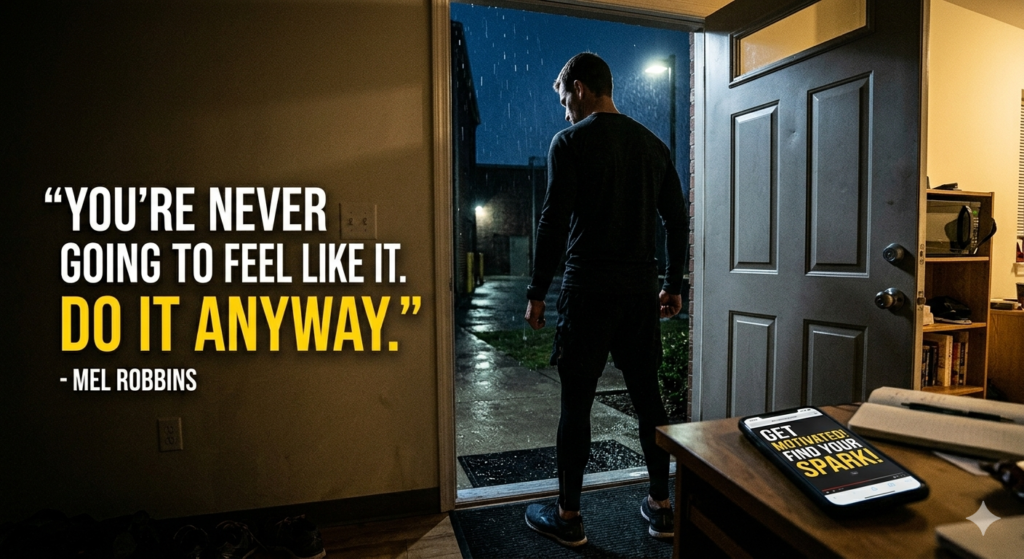
Mel Robbins, one of the most direct voices in personal growth, hammers this home in her famous TEDx Talk. She says, “You are never going to feel like it. Ever.” Your brain is designed to protect you from things that are difficult, uncertain, or scary. That’s its job.
If you wait for the “feeling” of readiness, you are essentially waiting for your survival-focused brain to give you permission to be uncomfortable.
Newsflash: It’s never going to happen.
The Reframe:
Stop asking yourself how you feel. Start asking yourself what you decided. Feelings are weather; discipline is the climate. The weather changes every hour. The climate is what defines the landscape.
3. The Jocko Willink Doctrine: Discipline Equals Freedom
You probably know Jocko Willink. He’s a retired Navy SEAL commander, a black belt in Jiu-Jitsu, and a man who looks like he’s carved out of granite. His philosophy is simple: Discipline Equals Freedom.
To the average person, this sounds like a contradiction. “If I’m disciplined and I follow a schedule and I force myself to do things, isn’t that the opposite of freedom? Isn’t freedom doing whatever I want, whenever I want?”
NO. That’s not freedom. That’s being a slave to your impulses.
- If you have no discipline with your diet, you are not “free” to eat what you want—you are a slave to sugar and lethargy.
- If you have no discipline with your finances, you are not “free” to spend—you are a slave to debt and stress.
- If you have no discipline with your time, you are not “free” to relax—you are a slave to the anxiety of unfinished work.
Discipline is the “down payment” on the life you actually want.
Jocko’s approach isn’t about being a “tough guy.” It’s about detachment. He talks about the “Internal Negotiator”—that voice in your head that tries to strike a deal with you.
- “Maybe we can just do 20 minutes today instead of 60.”
- “It’s raining, we should stay in.”
- “We worked hard yesterday, we deserve a break.”
Discipline is the act of shutting that negotiator down before he even opens his mouth. You don’t negotiate with terrorists, and you don’t negotiate with your own laziness.
4. The David Goggins Method: Callousing Your Mind
If Jocko is the commander, David Goggins is the monk of suffering. In his memoir Can’t Hurt Me, Goggins introduces the world to the “40% Rule.”
The 40% Rule states that when your mind tells you that you are finished—that you are exhausted, that you can’t go any further—you are actually only at about 40% of your true capacity. The other 60% is locked behind a “governor” in your brain that is trying to keep you safe.
Goggins doesn’t talk about motivation. He talks about being “uncommon amongst uncommon.” He talks about “callousing the mind.”
Think about how you get a callus on your hand. You don’t get it by rubbing lotion on it. You get it by creates friction. You get it by gripping the bar until the skin breaks and heals thicker.
Your mind works the same way. Every time you do something you really don’t want to do—like taking a freezing cold shower, running in the rain, or finishing a boring report without checking your phone—you are adding a layer of callus to your brain.
What Worked For Me:
I used to be the king of “starting on Monday.” I’d buy the journals, the apps, the memberships. I’d be “motivated” for three days, then I’d hit a snag, and I’d quit. What changed? I stopped trying to make it “fun.” I accepted that some parts of growth are just going to suck. I stopped looking for the “hack” and started looking for the “heavy lifting.”
5. The Science of Habits: Why Discipline is Easier than Willpower
Let’s get practical. You cannot rely on raw “willpower” forever. Willpower is like the battery on your phone—it’s full in the morning, but by 8:00 PM, after a day of decisions, it’s in the “Red Zone.”
This is where James Clear and Atomic Habits come in. Clear argues that we don’t rise to the level of our goals; we fall to the level of our systems.
Discipline isn’t about having a “stronger spirit” than everyone else. It’s about having better systems.

The “Environment Design” Strategy
Most people fail because they try to be disciplined in an environment that rewards laziness.
- You want to stop eating junk food, but you keep Oreos in the pantry.
- You want to wake up early, but you keep your phone (your alarm) right next to your pillow so you can hit snooze six times.
- You want to write a book, but you have 15 tabs open, including Netflix.
Stop trying to “out-willpower” your environment. * Put the Oreos in the trash.
- Put your phone in the bathroom across the hall.
- Use an app blocker.
Discipline is the initial choice to set up the system. Once the system is running, it does the heavy lifting for you.
6. The “Sisu” Philosophy: The Power of Perseverance
There is a Finnish word that doesn’t have a direct English translation: Sisu.
It’s not just “bravery” or “grit.” It’s a specific type of inner strength that only appears when you are at the end of your rope. It’s the “extra gear” you find when you have absolutely no reason to keep going, but you do it anyway.

Angela Duckworth, in her research on Grit, found that the single greatest predictor of success isn’t IQ, talent, or even luck. It’s grit—the passion and perseverance for long-term goals.
Motivation is the sprint. Discipline/Grit is the ultramarathon.
When you look at people who have truly “made it,” you aren’t looking at people who were constantly “inspired.” You are looking at people who were bored out of their minds for years, doing the same repetitive, mundane tasks, but they refused to stop.
Steven Pressfield calls this Turning Pro. The amateur waits for inspiration. The professional shows up and gets to work, whether the Muse is there or not.
7. The A.C.T. Framework: Your Blueprint for Discipline
I don’t want you to leave this page feeling “hyped.” I want you to leave with a plan. Here is how we bridge the gap from a “Motivation Addict” to a “Discipline Practitioner.”
Phase 1: A — Acceptance (The Truth)
Accept right now that the feeling of “not wanting to” is not a stop sign. It is a signal that you are at the border of your comfort zone.
- Reflection Prompt: What is the specific thought your “Internal Negotiator” uses to make you quit? Is it “I’m too tired”? Is it “I’ll do it later”? Write it down. Call it out.
Phase 2: C — Commitment (The Non-Negotiables)
You need to create a “Rule Book” for your life. Most people operate on “preferences.” Successful people operate on “principles.”
- Action Step: Pick TWO things that are non-negotiable. No matter what.
- Example: “I will walk for 20 minutes every day, even if it’s raining, even if I’m sick, even if I’m busy.”
- Why? Because you aren’t just walking; you are proving to yourself that you are a person who keeps their word.
Phase 3: T — Threshold (The Five-Second Rule)
As soon as you feel yourself hesitating, you have a five-second window before your brain kills the idea.
- The Tool: 5-4-3-2-1-GO.
- Physically move your body. If you’re in bed, sit up. If you’re on the couch, stand up. Action creates its own momentum.
8. Relatable Struggle: Why I Almost Quit This Article
Let’s get real. About halfway through writing this, I hit a wall. I started thinking, “Is this long enough? Does this sound like me? Maybe I should go get a coffee and finish this tonight.”
That was my “Internal Negotiator.” He’s a charming guy. He makes a lot of sense. He told me I’d be “fresher” later.
But I know his game. I’ve listened to him before, and he’s a liar. If I had stopped then, I’d be sitting on the couch right now feeling a low-grade sense of guilt and anxiety.
Instead, I stayed in the chair. I took a deep breath. I typed one more sentence. Then another. And now, we’re here.
The “win” wasn’t finishing the article. The “win” was the moment I chose to keep typing when I felt like stopping. That is where the muscle is built.
9. The Role of Compassion: Why Discipline Isn’t Self-Hate
A lot of people think discipline means being a jerk to yourself. They think it’s about constant self-flagellation and “tough love” that borders on abuse.
Believe me, that doesn’t work.
If you hate yourself, you won’t sustain the discipline. True discipline is actually a form of self-parenting. Think about a good parent. A good parent doesn’t let a child eat ice cream for breakfast and stay up until 3:00 AM just because the child “feels like it.” Why? Because the parent loves the child and wants them to be healthy and successful.
When you force yourself to go to bed early, or to save money, or to finish your work, you are being a good parent to your future self.
- Self-Indulgence is wanting the best for yourself now.
- Self-Discipline is wanting the best for yourself forever.
10. The Long Game: Discipline as a Life Philosophy
So, where do we go from here?
The world is going to continue to try and distract you. Companies are spending billions of dollars to hack your dopamine, to keep you scrolling, to keep you “reacting” rather than “acting.”
If you rely on motivation, you are a pawn in their game. You are predictable. You are easily swayed by the next shiny object or the next viral trend.
But if you are disciplined? You are dangerous.
You are a person who can set a goal and actually achieve it. You are a person who doesn’t need a “boss” or a “coach” hovering over you to get things done. You are a person who is in control of their own destiny.
The Recap:
- Motivation is a chemical spike; it’s temporary and unreliable.
- Discipline is a system; it’s a muscle that gets stronger with every “no” you say to your impulses.
- Your brain is wired for safety and comfort; you must consciously choose discomfort to grow.
- Freedom is the result of discipline, not the absence of it.
Your Next Step (No, Really—Do This Now)
I want you to close this tab in a second. But before you do, I want you to identify the one thing you have been waiting to “feel motivated” for.
Is it a conversation? A workout? A project? A habit?
Do not wait until tomorrow. Do not wait until Monday.
Do not wait until you’ve had a “good night’s sleep.”
Spend exactly five minutes on that task right now. Use the 5-4-3-2-1 rule.
Believe me… the version of you that exists on the other side of this effort is going to thank you.
The spark is dead. Long live the grind.